8-agent AI system automating resilience assessments for pharma and regulated industries—triangulating documents, surveys, and interviews through DAG orchestration to deliver first pass evidence-backed maturity findings in minutes, not months.
Business continuity consultants in pharma and other regulated sectors need to triangulate multiple evidence streams—BCPs, employee surveys, stakeholder interviews—to produce validated maturity assessments for ISO 22301, BS 65000, and sector regulators. Manual synthesis requires significant time and tailored expertise per domain and is prone to bias. Critical industries need AI augmentation that maintains consultant expertise while delivering audit-grade traceability.
An AI-enabled automation workflow deploying 8 specialized AI agents coordinated through directed acyclic graph (DAG) workflows. Agents process documents, surveys, and interviews in parallel, then triangulate findings across all three evidence streams using the Design-Perception-Reality framework. Every maturity score links back to specific evidence with line-level citations.
Key Innovation: Hybrid intelligence model combines heuristic agents (fast, deterministic) with LLM synthesis (nuanced, context-aware) for optimal cost-efficiency and quality. Flexibility in integrate more complex agents and underlying AI models for increased performance if required.
Maps regulatory requirements from ISO 22301, BS 65000, ISO/IEC 27001 to maturity domains. Provides clause-level citations with page numbers for audit traceability. Ensures assessments align with pharma compliance frameworks.
Extracts policy evidence from BCPs, frameworks, and procedures. Returns structured claims with exact section names and line ranges. Evidence-by-design preprocessing adds line annotations for precise source tracking.
Analyzes stakeholder perception data across organizational functions. Detects outliers and confidence gaps with respondent-level citations (ID, business area, role). Quantifies perception vs. documented reality.
Processes qualitative interview transcripts to extract operational reality. Preserves conversational context with turn-level citations (participant, turn number, date). Surfaces what actually happens vs. what policies claim.
Cross-validates findings using Claude Sonnet 4.5 with the Design-Perception-Reality framework: What policies document (F2), what stakeholders believe (F3), what operations reveal (F4). Automatically detects contradictions with confidence scoring.
Coordinates F1-F5 through DAG workflow (Standards → [Documents + Surveys + Interviews] parallel → Triangulation). Generates complete maturity findings with BS 65000 scores, narratives, recommendations. For typical organisational node engagement, reduces analysis from 40+ hours to <2 minutes per domain.
Combines heuristic gap calculation (target - current maturity) with LLM-generated implementation actions. Prioritizes initiatives across Quick Wins, Critical Path, Schedule, Consider quadrants with 3-5 step guidance.
Transforms gaps into quarterly implementation roadmap (Q1-Q4). Uses keyword-based dependency detection and rule-based sequencing. Automates strategic planning deliverable creation in <1 minute.
25 policy documents analyzed
68 survey responses across 5 business functions
12 stakeholder interviews (operations, quality, regulatory)
Governance • Risk Management • Business Continuity Planning • Operational Resilience • Culture & Awareness
Complete maturity assessment: <10 minutes (vs. 40+ hours manual)
47 evidence-backed findings with line-level citations
23 prioritized gaps across 5 domains
12-month implementation roadmap with dependency chains
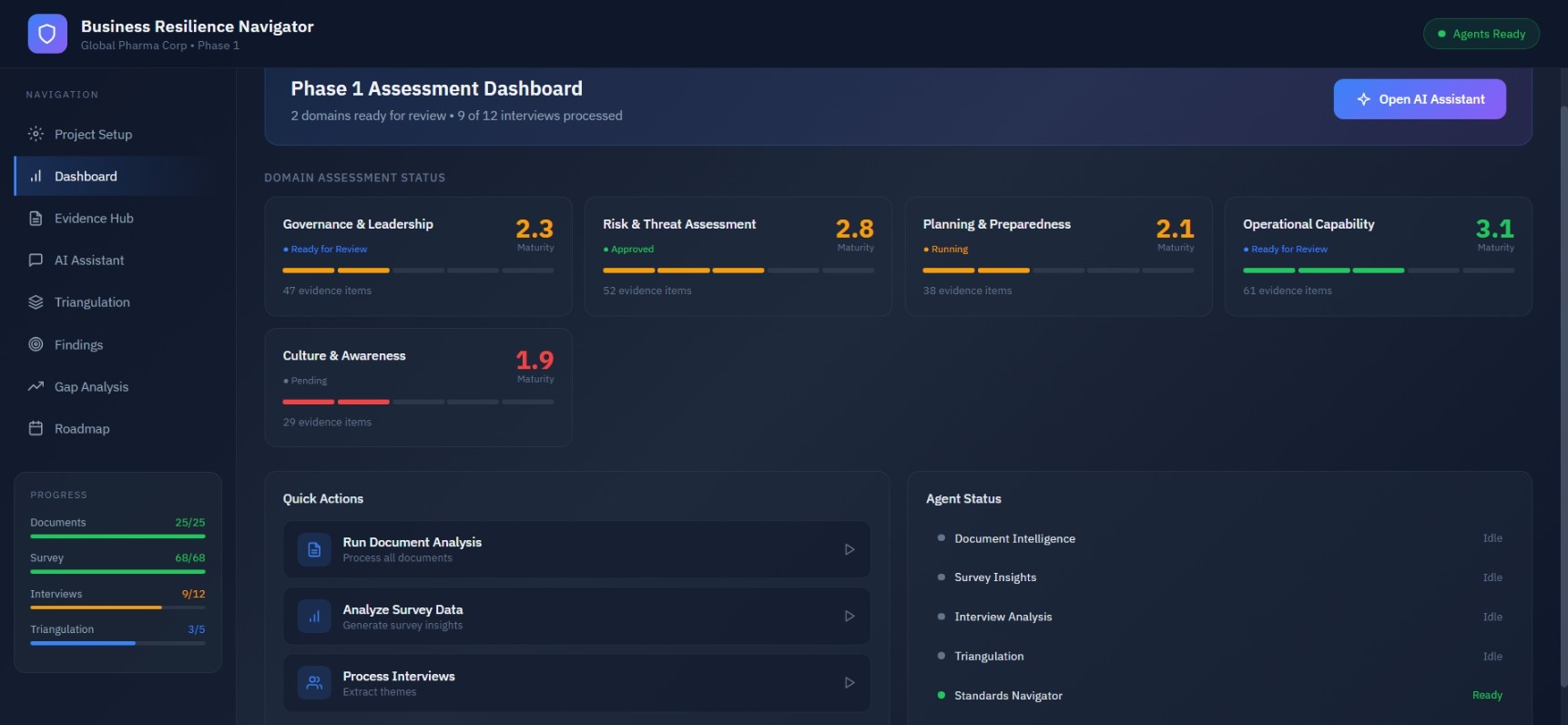
Central hub showing project setup, multi-agent status, and evidence collection progress. Track which AI agents are active, idle, or processing across documents, surveys, and interviews.
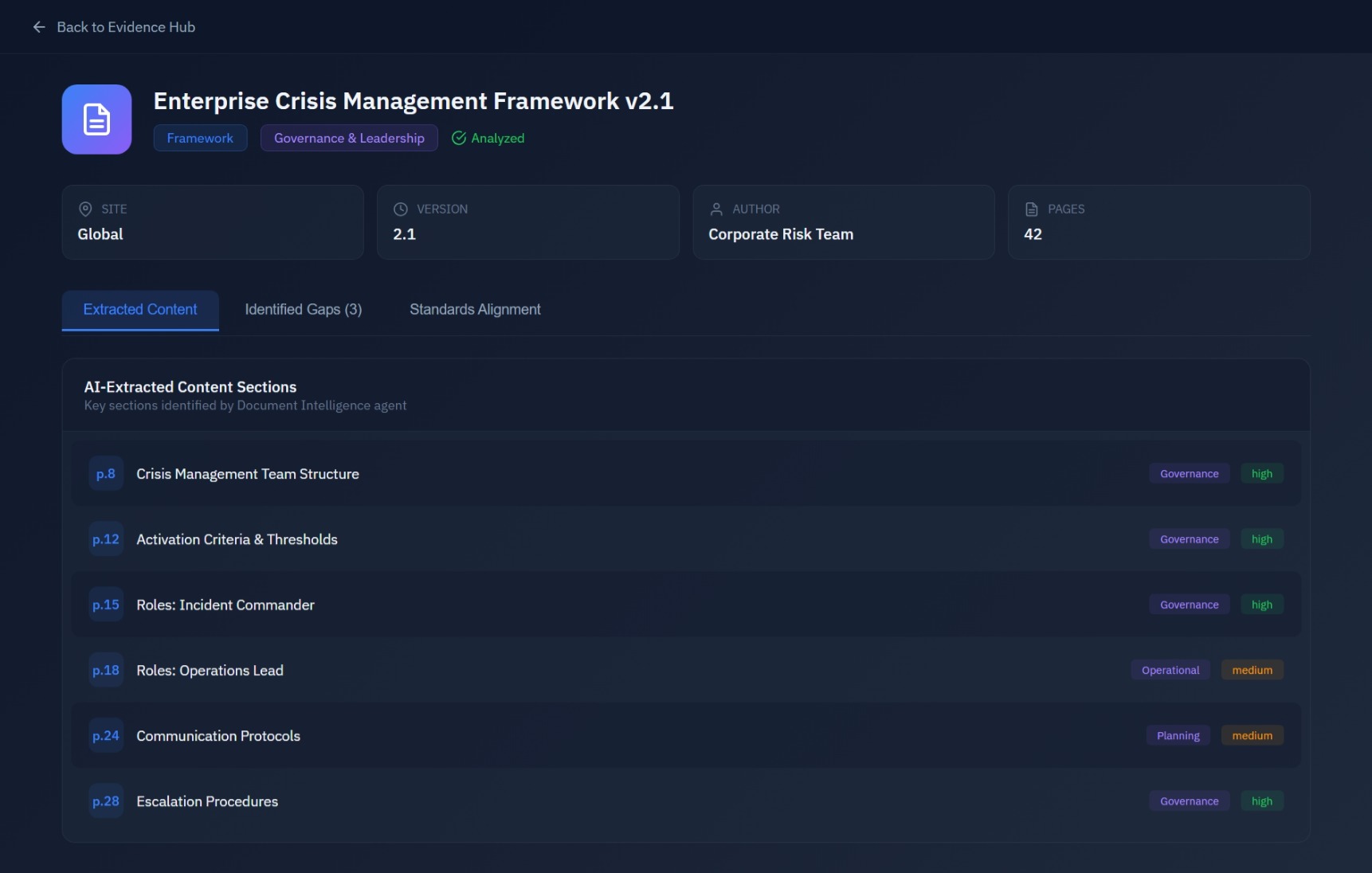
Deep analysis of business continuity plans and frameworks. Extract key sections, identify gaps against standards (ISO 22301, BS 65000, BCI GPG), and map to resilience domains with line-level citations.
Function-by-function breakdown of survey confidence scores. Detect outliers, analyze question-level patterns, and surface perception gaps across organizational units with respondent metadata.
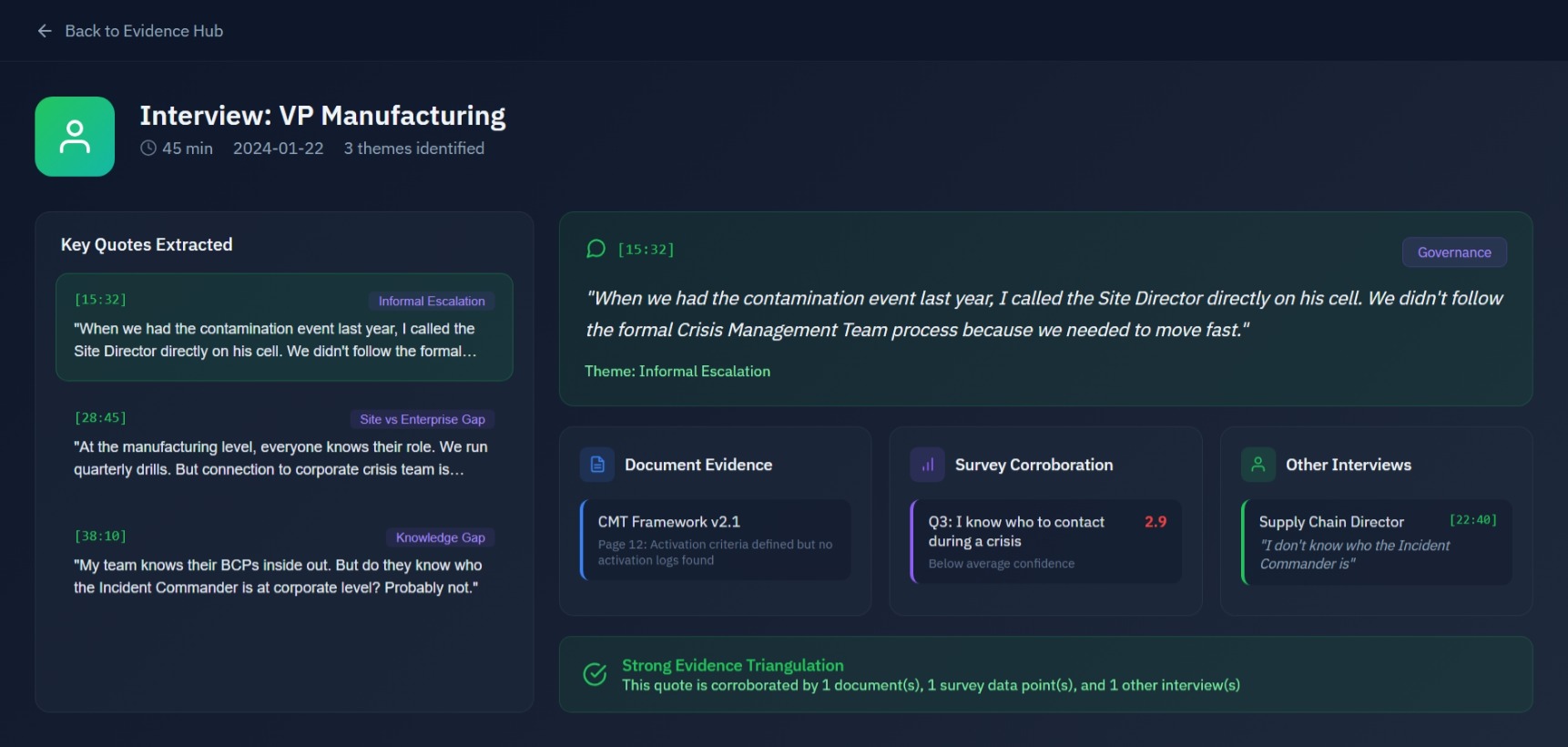
Extract quotes from stakeholder interviews and cross-reference with documents and surveys. Link contradicting or confirming evidence across all three streams to validate operational reality.
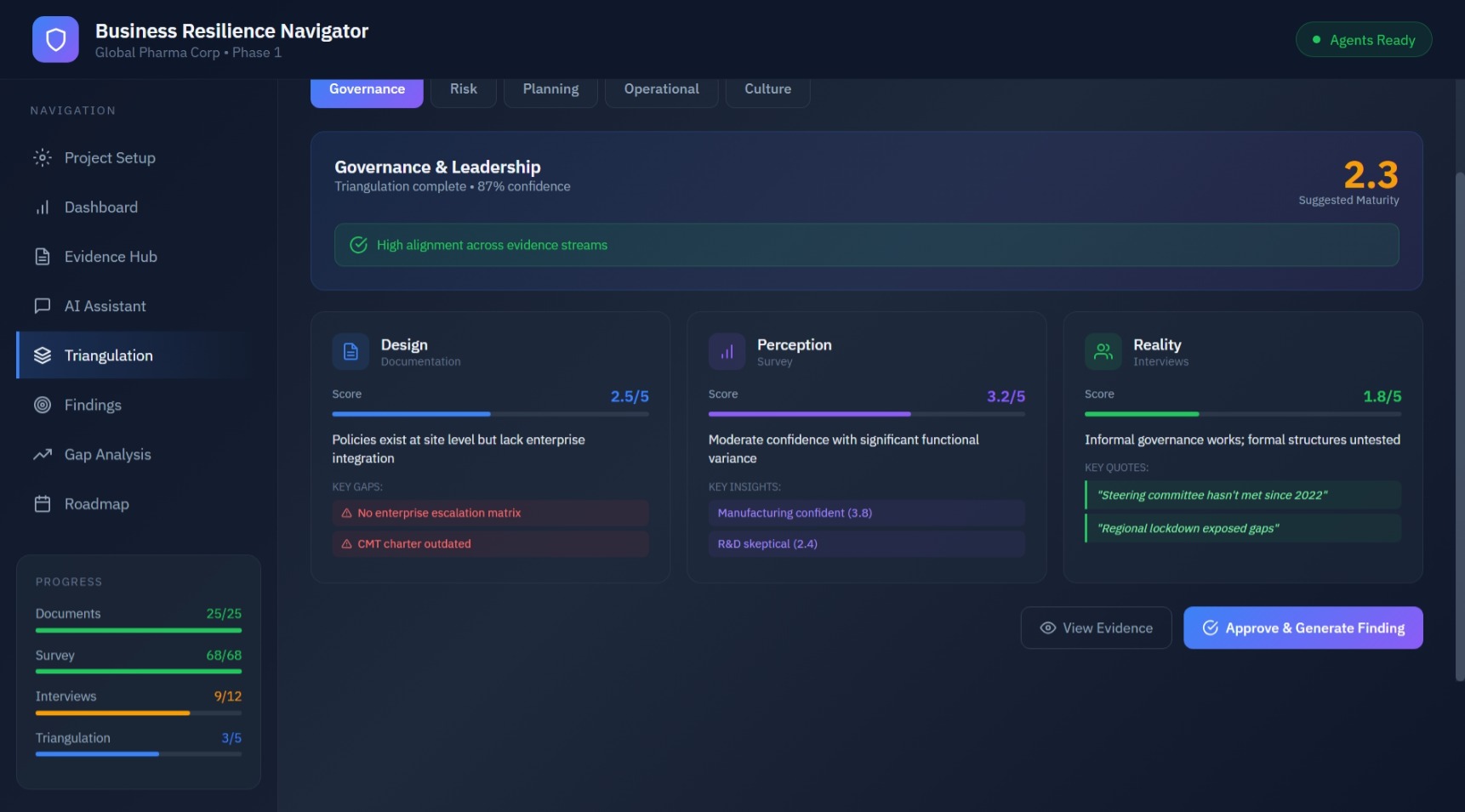
Unified view of validated findings with confidence scores. Review AI-generated insights marked as "Draft," add consultant notes, and approve findings before client delivery. Design-Perception-Reality framework in action.
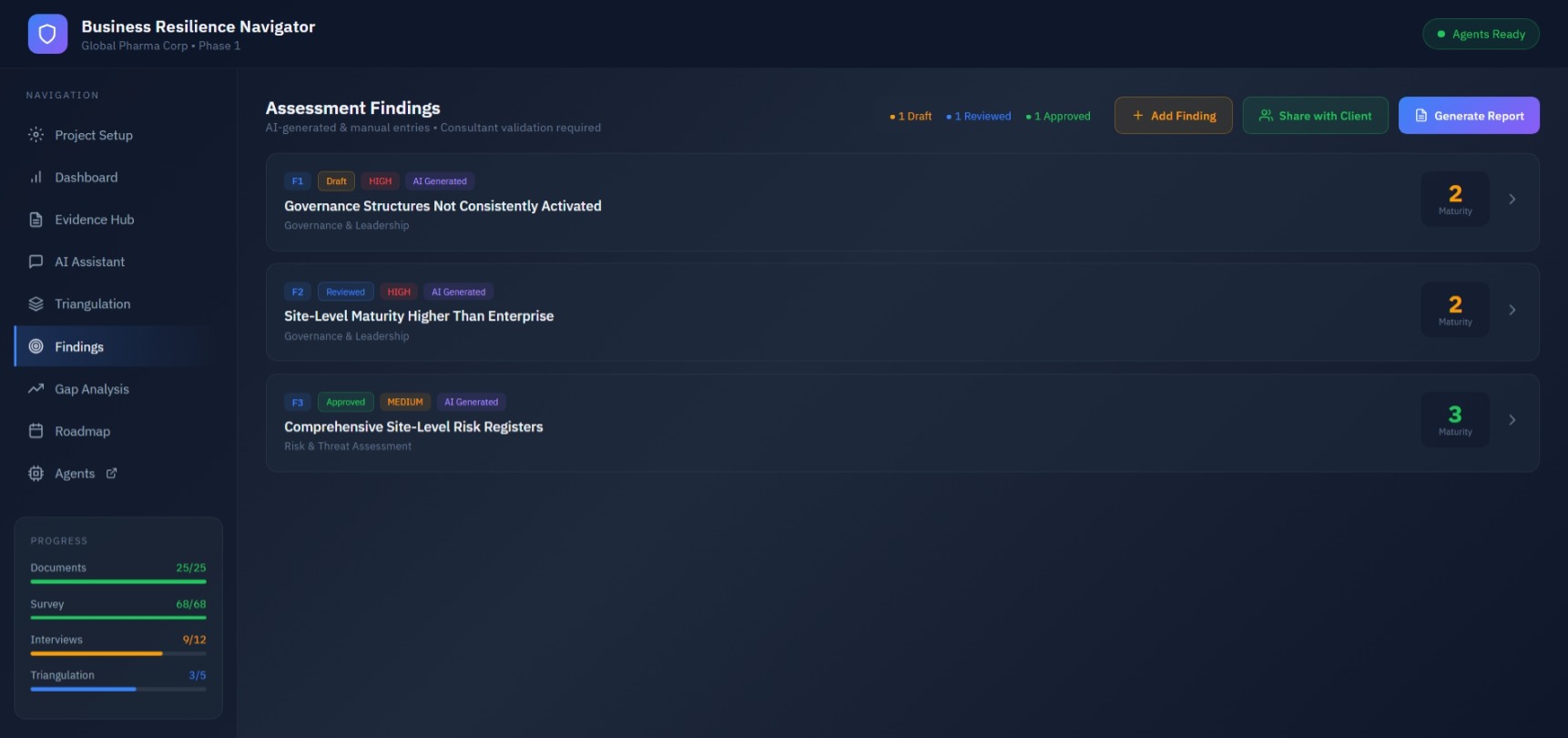
AI-generated and manual findings with consultant validation workflow. Track draft, reviewed, and approved status. Add maturity scores and link to governance domains with complete evidence traceability.
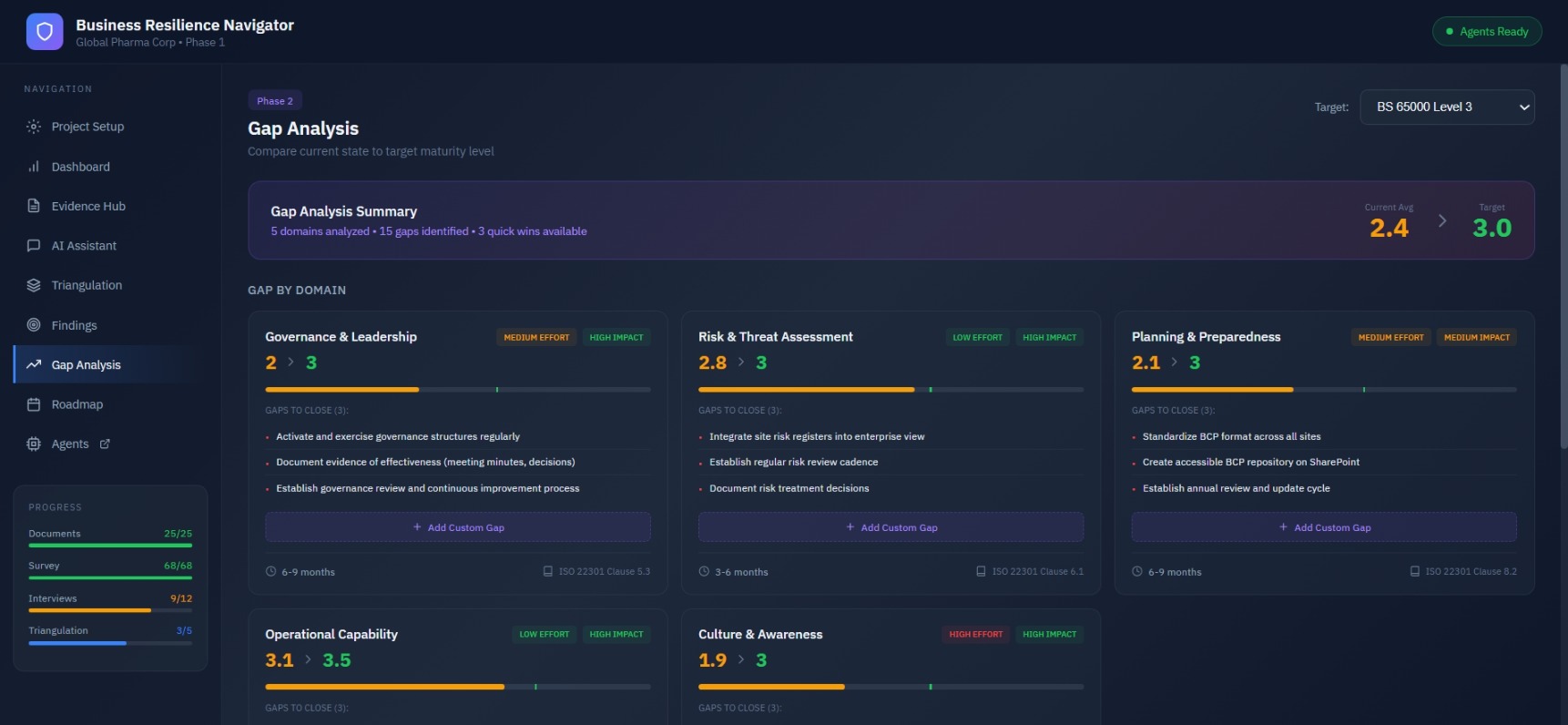
Compare current state to target maturity levels across resilience domains. View gaps by domain with effort and impact indicators, recommended actions to close gaps, and alignment to ISO 22301 clauses.
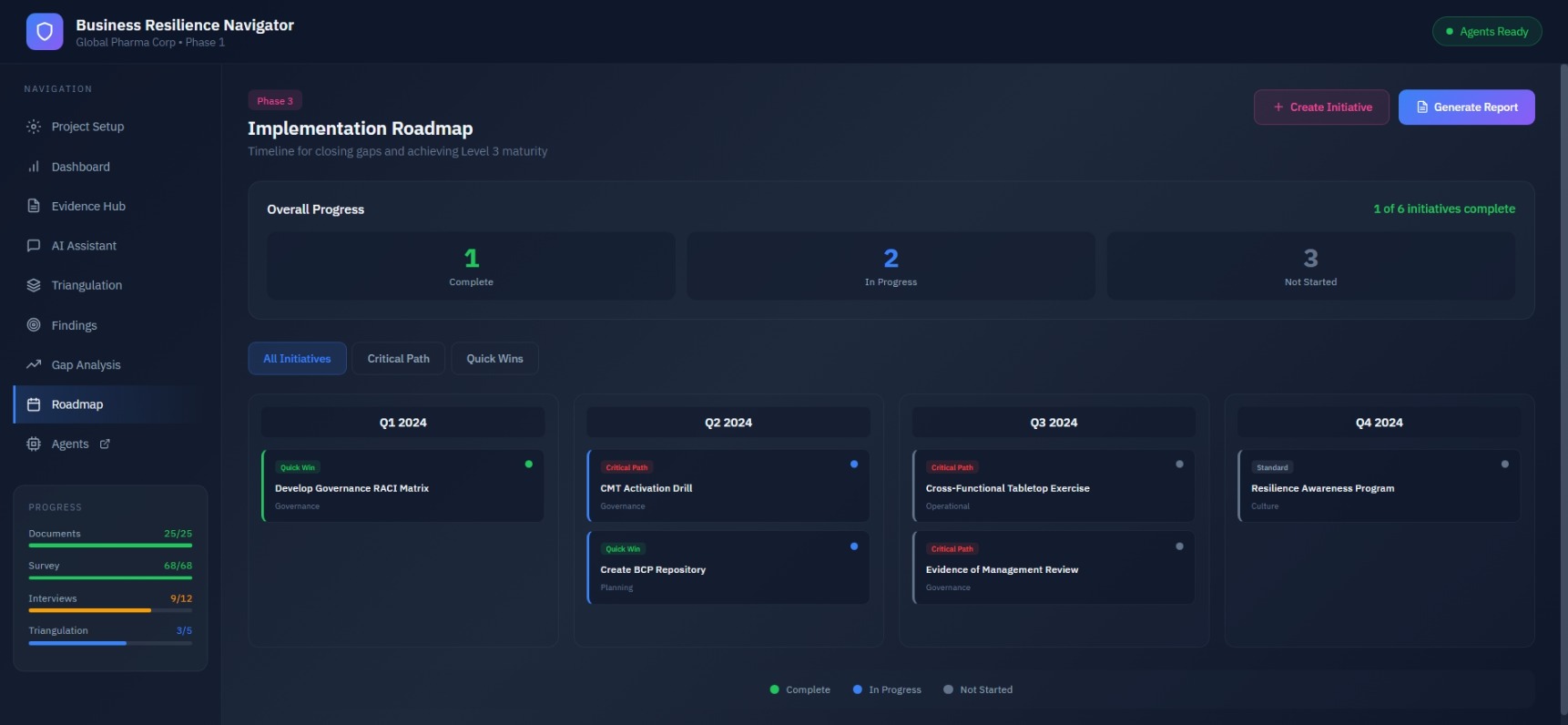
Timeline for closing gaps and achieving target maturity. View initiatives by quarter with quick wins and critical path items. Automated dependency detection and sequencing across Q1-Q4.
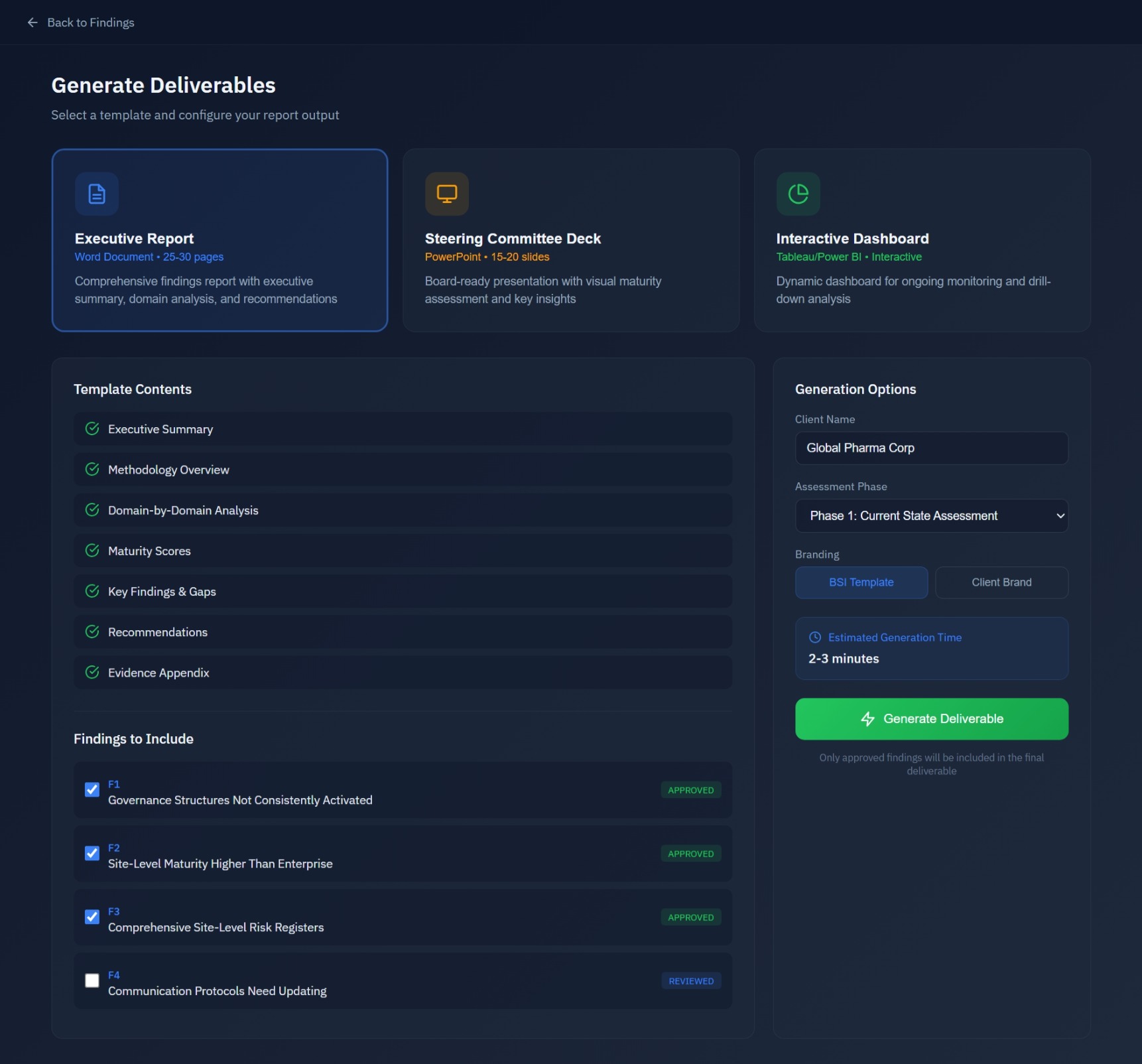
Export to Word (executive reports), PowerPoint (board decks), or interactive dashboards. Select findings to include, customize templates, and generate client-ready deliverables with evidence citations.
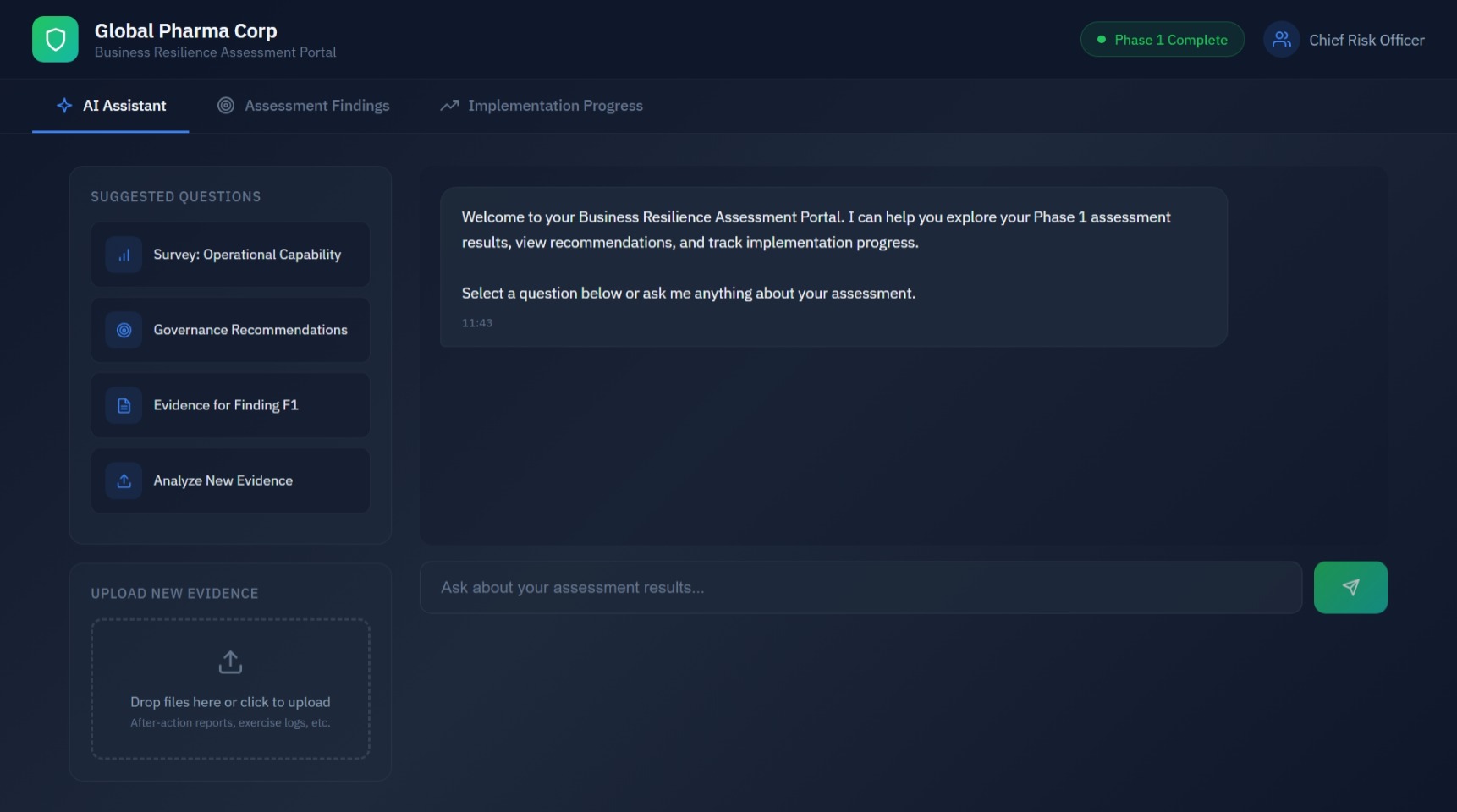
Client-facing AI assistant interface for exploring assessment results. Ask questions about survey responses, recommendations, and evidence. Upload new documents for real-time analysis.
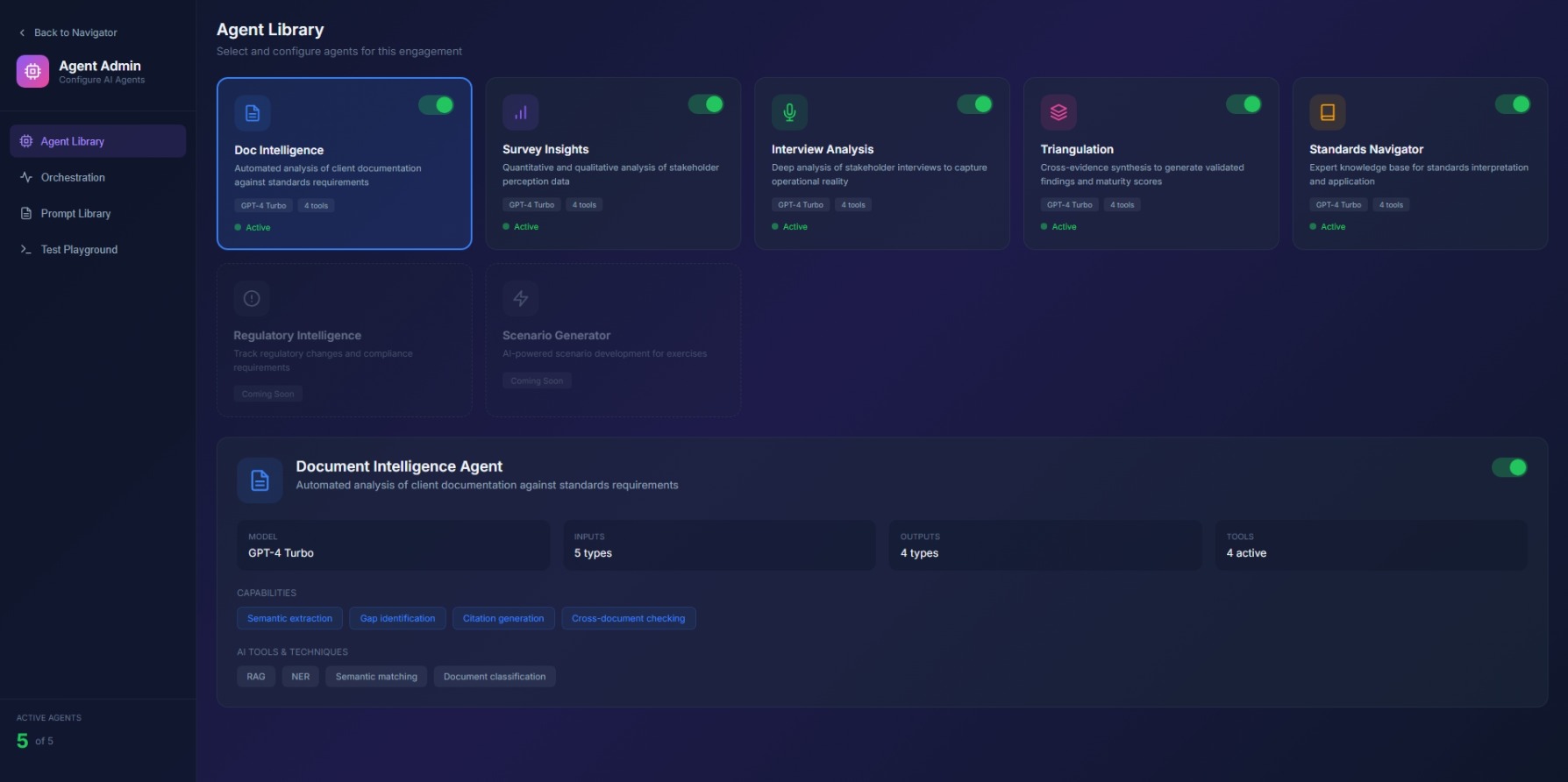
Select and configure agents required for augmented assessment workflows. DAG orchestration management console showing agent dependencies and execution status.
DAG coordination of 8 specialized agents transforms months of manual analysis into minutes of intelligent synthesis. Foundation agents (F1-F4) extract evidence in parallel; synthesis agent (F5) triangulates findings with complete source traceability.
Automated triangulation across policies, surveys, and interviews surfaces contradictions instantly. Example: Policy documents claiming annual exercises vs. interviews revealing 18-month gaps. This framework is critical for pharma compliance validation.
Building citation traceability into preprocessing—not retrofitting—creates the audit trail pharma and financial services regulators demand. Every finding links to specific evidence with line-level precision.
Heuristic agents (F1-F4, P3) provide fast, deterministic processing. LLMs (F5, P2) handle nuanced synthesis and creative action generation. Result: 9 LLM calls per analysis vs. 40+ if fully LLM-based.